As part of their War on Christmas, liberal academic intellectuals plot their major hiring interview barrages for big conventions in the week between Christmas and New Years -- this week.
The premise is that all the graduate students who have recently, or will soon, pry a PhD from their advisors' hands send out scores of job application packets in the Fall, then all the schools choose those they'd most like to toruture and request an interview at the big holiday conference in thier field. The Modern Language Association Convention, where my wife's friends go to suffer, is being held in Washington D.C. this year. Many of my friends have their Geneva Accord rights violated at the Eastern American Philosophical Association Conference, this year in New York.
While there, the schools shove all the prospects in small cages, then cut off their beaks so they don't injure the other merchandise. Or perhaps that was a flashback. Theoretically, this is all efficient since they don't have to fly a bunch of squrirrely, likely to to set off some Homeland Security watch list, graduate students and recent graduate students, all over the place -- everyone just meets in the big hall and does this kind of speed-dating for nerds thing.
Our friends: Su Weixing, Sara Warner (check out her website; modern nerds are nerds in multiple categories!), and Kristen Abbey all got the short stick and have to go to Washington to experience the Cheney special. Gary Bartlett at least doesn't have to travel too far, but I hear that next year they're going to drop the charade and just hold the Eastern APA in Gitmo.
College teaching doesn't pay as well as other long, slow, awful degree processes, but setting your own hours, working on something interesting, and long summer "research" breaks seem more than enough to sucker lots of people into trying to enter the field. But, the truly bad part, I think, is how little control one has over where one will live. You're pretty much stuck with the places that were available when you got out -- and all too often that seems to be here.
Gary actually managed to score interviews for places on both coasts (and, er, there...) so mucho congrats!
Wednesday, December 28, 2005

Wednesday, December 21, 2005
Tests and Training Scenes
Not to pick on my friend, Scott, but here I’m going to pick on him. Occasionally he’d run a game of Champions for the rest of us and our superheroes would end up fighting some mildly challenging bad guy, only to later discover that the fight was all set up by some mastermind to test us—so that he could find out if we were suitably heroic for the mission. Of course, somewhere inside our reptilian brain it occurred to us that who else was he going to get for the mission? Recruit the clerk at the Circle K next door, have him write up a character, and send him on the mission?
The superfluous action scene had found its way into the creative arsenal of the next generation.
In Scott’s defense, here’s just a short, trillion dollar or so list, of films with similarly superfluous action scenes:
2 Fast 2 Furious: Drug boss has a test to go to work for him—Paul Walker and Tyrese have to race some yahoos through
Paycheck: We see here the strangely common instance of an extended first act scene showing Ben Affleck practicing martial arts. Truly, it's riveting wondering if the dungeon master is sucker enough to give him experience points or a skill check for this. Though in this case I think the idea is that we need to see him doing the kung fu thing so we understand later in the film when this reverse engineering geek kicks ass. I guess just showing a trophy on the mantle wouldn't cut it. Regardless, it's better than:
The
Saturday, December 17, 2005
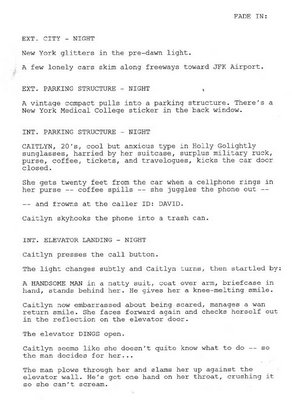
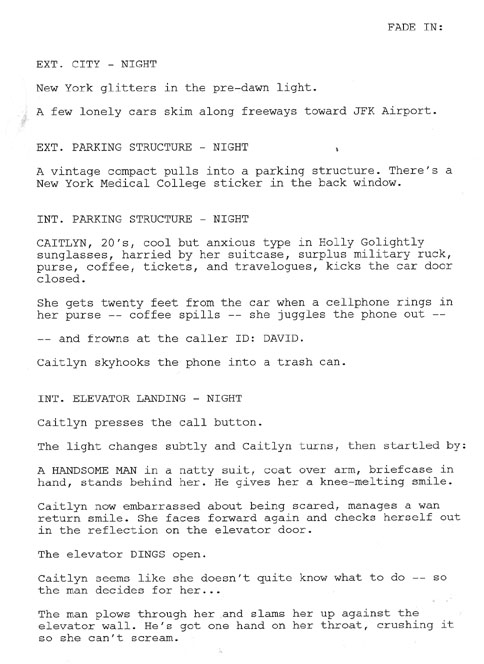
One Page Post
Here's my one page for the one-page post thing started up by Red Right Hand. I'd like to use John August's nifty technique for splatting scripts into the web, since it retains the formatting and reads well--but I lack the skillz to do so (and suspect Blogger will slap me around anyway). I'll punt to the jpeg instead (click to engorge):
Tuesday, December 13, 2005
Friday, December 09, 2005
Notes From Wilderness: Querying
This is probably the last, or maybe only, bit of information I have that's actually useful. I’ll cover various methods to get reads, not just queries. This will be a monstrously long post I’m afraid, but I thought it best to put it all together instead of breaking it up into multiple posts.
I've experimented with a few methods of trying to get material read by people who could possibly get it made so I thought I'd share my experiences. Let's start with the worst method:
Snail Mail Query Letters
As mentioned in the previous post – this technique can turn your 37 cent investment into $15 of work at the far end of the line. Recently I gave this a significant try, sent out about 200 query letters in envelopes. Fortunately, they have stamps you don’t need to lick. Unfortunately, the redi-strip envelopes jam in my printer so there was still plenty of licking involved.
Of those 200 queries I’ve received, let me see here… counting… counting… oh, that’s right, zero requests for a read. I have since received 4 requests for that same script via an eQuery service.
Admittedly, these were all blind queries, but they were addressed to specific people at the places. Since my data was a tad out of date a fair number came back as undeliverable. However, given the added effort and cost of this technique, it would have to be significantly better than other methods to be worthwhile.
InkTip’s Script Listing Service
For those unfamiliar with the service this is a website where you pay to list your screenplay for a period of six months and production companies can look at its short description and download the screenplay, if they desire. This activity is tracked and reported to you so you always know who has read your synopses and screenplays, and who has at least gotten a glance at your logline.
This hasn’t worked well for me. I’ve had three screenplays up for about six weeks. So far the loglines have been viewed a total of 66 times by 26 different companies—most of these companies have few or no production credits.
Of those viewings, 2 have gone on to look at the synopsis I posted, but none have actually looked at the screenplay. That may be due to subpar synopsizing or lackluster loglining, but I’ve had better success using other methods and this post is really just about sharing what methods have worked best for me at getting my stuff in front of people (and hopefully getting stuff happening after that).
My BIG caveat to the above: the screenplays I’ve posted there are not cheap to make – as in, not less than $1 million. Also, I’m forthcoming about this and mark the appropriate check-box in their listing form. Given that so many of the companies look like places that are starting up, and they can choose search criteria that would include cost, the relatively high cost might even be reducing the number of times my logline shows up.
The script I’m working on now should be very inexpensive to make and I definitely plan to post it on InkTip so I’ll come back in a few months with an update to say whether or not micro-budget seems to make much of a difference.
Lastly, fellow San Antonian, ScriptWeaver (warning! link may not be safe if your girlfriend or wife is looking over your shoulder), has enjoyed better success from InkTip (an assignment!!) and also from MovieBytes, a similar, but free service.
Contests
I haven’t entered many contests, largely because so many of them seem to look for high quality screenplays with in-depth characters and rich character arcs – and I write stories about new ways to kill people.
I do look for contests that have genre categories, such as the previously mentioned Screenwriting Expo contest (a quarterfinalist), and I went for the Project Green Light 3 contest (only made it past the “we’ve cut out the people who make us shudder at the tragic state of modern education” round), and I recently entered the Horror Screenplay Competition. I missed one of the other pure horror contests and kind of kick myself for that.
So far, these contests have neither resulted in direct reads, nor seemed to help get my screenplays read when I mentioned my stunning achievement of getting up there with 260-some other struggling screenwriters.
My personal feeling is that contests are one little piece of justice in the world. I write stuff that tends to do well with regular querying; but more dramatic or personal stories (or potato famine period dramas) do better in contests—which in turn might not get the movie made, but can bring the writer to the attention of the people who hire writers for other things.
ScriptPIMP
In addition to their coverage service, they also offer something called a Writer’s Database. This is a listing of about a thousand different production companies, agencies, managers, and entertainment attorneys. These listings are kept fairly up to date and often include useful information for screenwriters such as: whether the company accepts material from new writers, how best to submit a query, what kind of material the company prefers (film genres are especially nice since a fair number of place don’t want horror at all and some seem to only want horror), and a decent percentage also list some of their credits—which is probably the best way to figure out whether your script is a good fit for them.
One particularly nice feature of this database is that a decent number of companies accept queries directly through the ScriptPIMP website. You fill out a form with your own information and information about the script, then just press a button on the company’s listing and off the query goes. I’ve only received one request from maybe 30 to 40 queries, but in the cold-query biz that’s a stellar percentage. Moreover, it was from a good place and, while they passed on the first one, I followed up with my new piece and got another request.
Some companies mention that they prefer to see queries come this way. I suspect this is because when you use this system you also agree to a ScriptPIMP standard release form and this gives the companies enough legal comfort that they’re willing to accept unsolicited query letters. And, frankly, I don’t blame them for seeking a little additional legal protection.
eQuery Services: Script Express
This service is sold by So You Wanna Sell A Script, and has been the primary service I’ve used. Not so much because I’ve done extensive market research and decided on it, but because it’s worked fairly well so far so I might as well stick with it.
What it does is take a query letter you’ve written then send it via email to a large list of production companies, agencies, and managers. The email uses your own return address, so if someone hits reply it goes directly to you.
It is, of course, spamming. But everyone on the list receives these messages on a daily basis and can easily opt out, so I’m fairly confident that the people who receive it do so because, at least occasionally, they like to go trolling through the eQueries to see if there’s any possibles.
I’ve used the service five times and have gotten between 10 and 15 read requests the last four times. My first query scored fewer hits, but it did get one from Fox Searchlight, so even the big companies apparently take a look every now and then.
Again, many of the companies that have responded to me have been fairly small, but often with a few credits at least or a decent client list for the managers or agents. I will note that the most requests I got was for a teen comedy—and that one also got requests from larger places on average.
This is also the service through which I got in contact with the company that optioned THE SOUND. So, to defend these kinds of services to any potential producers that happen by here—not only can they help writers, but production companies can also find projects that interest them, if someone’s willing to wade through all the email.
Like the ScriptPIMP service above, I think there’s a sort of release form you go through when you use the service, so this might be another reason why companies are more willing to respond to these sorts of queries than they are to regular letters.
eQuery Services: eQuery Online
I just recently used this one for the script that I also tried the abysmal failure of the snail mail experiment on. Their website has a number of handy tips so is worth checking out for that reason.
All these services do pretty much the same thing—mass mail your query, likely to many of the same people. Both these companies also limit the number of queries they send per day, to avoid overloading the recipients. This usually makes for a short wait before they actually send your query out. I’ll talk here about the differences.
Instead of putting together your own query, this place has you fill out a form and include just a logline—albeit a somewhat more detailed one. Normally I include a shortish logline and a one paragraph micro-synopsis in my queries, but I hadn’t the vaguest idea how to do a synopsis for the last one so I thought it’d be a good time to give eQuery Online a try.
They were nice enough to give me some comments on how to improve my logline before sending it out—then, when they did so, they put together their own version of the query. This included mentioning the recipient by name in the body of the text to give it the illusion of personalization. This might work better than my “don’t have a Dear XXXX line at all” technique.
I then got five requests, some from decent sized companies. But also one from one of the producers of The Sound! Normally, these services include a place where you can tell them what companies not to email. I list there all the places where I’m able to contact someone I’ve corresponded with in the past—but apparently they messed up that part this time.
Unfortunately, here is also where the problems started showing up. Unlike Script Express, this service has the recipient respond to an email address they set up. eQuery Online then goes to that email account and forwards any emails to your regular email address—then you can go ahead and respond to the original recipient (and work out for yourself what you’re going to do about updating them about your real email address).
From the header information on the emails I received, it looks like the query was sent out Nov 30, and the four fresh responses were sent that day. However, I didn’t receive the forwarded messages until early Dec 4. So either they use an auto-forwarder that’s rather fritzy, or they have some person do it by hand and they were busy.
Also, after having received 4 fresh requests the first day, I’ve received no requests since then, not even “thanks, but not interested responses”. Having a little experience with queries, I’ve noticed a pattern in the responses that jibes with other patterns in nature. Normally I get about half my total number of requests on the first day, then a few over the course of the following week, and a smaller trickle after that—the same nice little geometric pattern that you also see in weekend box office tallies of major films. So, the absence of any following responses of any sort make me suspicious of this dead-drop email account plus forwarding system.
I followed up with some questions about the delay, lack of “no thanks” notes, and getting nothing from the following days, and whoever was at the other end only answered one of my three questions. I followed up with another email asking the other two questions and this time got a response that only answered one of those. Perhaps they have a one question per email rule that I somehow missed…
Now, I didn’t have high expectations for this particular query; four total responses would not surprise me. It did have the contest placement, but it’s an expensive film and that would likely be clear from the query, thus ruling out a bunch of companies right out the gate.
However, the lack of transparency in their process is really frustrating. Why the mysterious delay in receiving my replies? Why can’t I access the mystery account directly? I almost always get as many “no thanks” notes as I do requests, but none this time. And the customer service after the query needs some more time in development.
Previous Contacts
People who’ve read your stuff and responded well previously (even if they passed) are the most likely to request a read. Moreover, they’re more likely to give you some notes if they pass.
Final Note
Those are the methods I’ve tried. Others can tell you about cold-calling or making personal contacts. I do suspect that one side advantage of the pathetic query letter is that the people who do request a read are at least in the market for a script in your genre. You know they’re not reading it just because they like you.
Monday, December 05, 2005
Dire Unsolicited Query Letter

I experimented recently with sending out snail-mail query letters. These unsolicited letters are so toxic, and strike such fear into the heart of
The recipient sent it, unopened, directly to the firm’s legal department. A highly paid legal office worker then placed the unopened letter, along with a standard form letter on cotton-fiber company letterhead telling me that the query hadn’t been opened due to legal mumbo-jumbo, into an 8.5 x 11 envelope. They then sent that envelope back to me—certified mail so that they would have a paper trail showing that I received my unopened query letter.
Dire Unsolicited Query Letter
Tiny Construct
Hit Dice: 1/2 d10 (2 hp)
Initiative: +2 (+2 Dex)
Speed: 20 ft. (4 squares); flutter 20 ft. (poor); priority 2-3 days
AC: 14 (+2 Size, +2 Dex), touch 14, flat-footed 12
Base Attack/Grapple: +0/-9
Attack: Bite +1 melee (1d4-1 + 1d4 career damage)
Full Attack: Bite +1 melee (1d4-1 + 1d4 career damage)
Space/Reach: 5 ft./5 ft.
Special Attacks: Paper trail
Special Qualities: Construct traits, flammable, optional qualities
Saves: Fort +0, Ref +2, Will -5
Abilities: Str 8, Dex 15, Con —, Int —,
Skills: Disguise +4
Feats: —
Environment: Any coastal
Organization: Solitary or bulk (50-300).
Challenge Rating: 2
Alignment: Desperate
Advancement: —
Level Adjustment: —
The envelope is unremarkable, save for its thinness—just thick enough to hold a single folded page. It’s addressed personally to you, but uses the long version of your name. And who the hell do you know in
The dire unsolicited query letter (DUQL, for short) is the bane of beginning agents, assistants, and development executives. It typically comes in the form of a number ten envelope bearing a single piece of paper—but may include colorful pages, letters of recommendation from someone’s creative writing teacher, perfumed paper, mock-ups of potential movie posters, a potential cast list, a potential cast member, and underwear.
When first spotted, a potential victim may make a Sense Motive check opposed by the DUQL’s Disguise check. If the victim fails, the DUQL immediately attacks.
Combat
Paper trail (Ex): The primary threat posed by a dire unsolicited query letter is that it creates a paper trail linking you to a vague idea in such a way that you, your employers, your friends, your family, and other random acquaintances may be exposed to a lawsuit for being even remotely involved in a film to which one (i.e. a lawyer) could—with a small stretch—have a description that included one of the adjectives, verbs, or nouns found in the letter.
Not opening the letter and quickly handing it back to the letter carrier, or to your firm’s highly trained strike force of legal commandos is the best way to minimize the career damage suffered.
Each successful hit by the query letter delivers 1d4 career damage, in addition to the normal damage. The career damage you’ve suffered serves as a penalty on Profession check to gain a promotion or increase your Wealth rating. Any unsuccessful Profession check for either of those purposes removes all accumulated career damage.
Flammable (Ex): It is made out of paper after all. DUQLs suffer double damage from fire.
Creature Options
Like mini-templates, gamemasters may add these options, mixing and matching as they see fit. These options modify what the DUQL can do, and may also modify the DUQL’s challenge rating.
□ To Whom It May Concern (Ex) [-1 CR]: Not addressing a particular person makes this a dead give-away. The DUQL suffers a -5 on all Disguise checks.
□ … You See, It’s A Period Drama… (Ex) [-2 CR]: It’s a brilliant and touching script that won oodles of awards… covering the tragic plight of a young peasant woman living through the Irish Potato Famine.
There’s little chance you’ll ever be involved in this sort of a film; if you are so involved, there’s little chance the writer will ever see the film; and if the writer does see the film, they won’t be able to get any money out of your now-bankrupt movie studio.
The DUQL’s attacks only hit on a natural twenty and those hit may make a Reflex save (DC 5) to avoid all damage.
□ Certified (Ex) [+2 CR]: The victim of the DUQL must sign for it—giving the screenwriter a permanent record that the letter made it past the shields.
The results of this are dire—increase the critical threat range for all attacks to 18-20 and any successful attack also deals 1d3 permanent points of Conceptual Taint. When the hapless victim gets involved in any future films they must roll 1d20 and add the total number of Conceptual Taint points they’ve suffered. If the roll beats DC 20, then the film suffers a plagiarism lawsuit.
There is no known way to remove Conceptual Taint, unless you have access to a druid of at least 7th level. On the upside, certified letters are so inherently scary that victims receive a +2 bonus to their Sense Motive check when first encountering the DUQL.
□ Priority (Ex) [+1 CR]: In addition to using the expedited speed of 2-3 days delivery time, the envelope looks more official, is larger, and more sturdy.
Increase the DUQL’s size to Small, making all normal adjustments for size. Give it a +2 Strength and -2 Dexterity. Increase the hit die to a d10 (6 hp) and grant it +1 natural armor. Due to the official look of priority mailing, the DUQL receives a +2 equipment bonus to Disguise checks.
****
Why did I sign for it?! What could I possibly have been thinking? It was a doomsday scenario. The letter would haunt me the rest of my days: “A team of vampire and werewolf supermodels must battle cybernetic terrorists from the future, bent on converting the world to their cultish religion -- IN THE PAST.” Every studio film (that makes money) includes at least one of those elements.
I considered getting killed then resurrection -- but that wouldn't work. My only hope was getting killed, then a reincarnation spell where I come back as a badger...
All text of the DUQL is designated Open Content and released under the Open Gaming License. The Open Game Content may only be Used under and in terms of this License.
Thursday, December 01, 2005
Strange Mirrors
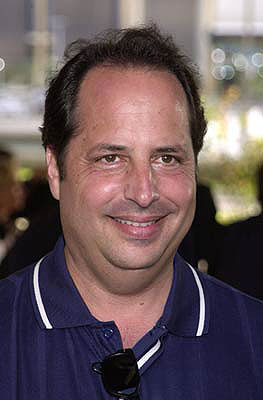
Back from L.A. after the holidays. Phoenix airport maintains its record of 50% late departures. You know how you sometimes see someone's double? What's particularly disturbing is seeing someone's double who happens to be of a different ethnicity -- such as the Filipino Jon Lovitz I saw while waiting for my delayed plane.
Next week I'll have a little post on query letters and trying to get reads.
Tuesday, November 22, 2005
Notes From Wilderness: Getting Notes

I'll skip right past the whole, writing the screenplay business because that's such an insignificant part of the process...
After you've got the draft to the point where you can't see what's wrong with it anymore, it's time to send it out for notes. This is not an optional part of the process.
Feedback Exchanges: I've gotten fairly solid notes from Helium Feedback's service. I recommend actually shelling out some bucks for the service -- since people are more professional when there's money at stake and they're held accountable for their performance. Also, since the prices are typically much cheaper than other places, you might want to dive straight in and get two sets of notes. These are, by and large, schlubs just like us, but by getting feedback from multiple people you can see if there's a trend.
Another important note: check to see what genres the various readers work in and, all else bein' equal, choose the ones that have done some writing in your genre. This is, I think, a great failing of writer's groups, many reading services, and even production companies.
For instance, with horror everyone thinks they know good horror even if what they really go out of their way to watch is nihilistic documentaries but they happened to like Alien. Everyone liked Alien -- but only after Aliens came along and made Ripley cool. I liked When Harry Met Sally but you sure as hell don't want me giving you advice on romantic comedies. My tastes in comedy are neither commercial, nor critically refined. So unless you think Harold & Kumar Go To White Castle was the best comedic film of the past 2-3 years don't ask me for advice on your comedy script.
Online Services: I've used ScriptPIMP multiple times and gotten generally good advice. Often the notes will point you toward some key weaknesses -- but you don't have any control over the reader and so, depending on the genre of your work, you might get advice that pushes away from what would actually be best for your kind of film. If you're still learning the format and structure this won't matter much, but it can undermine the value if you're looking for broader notes on how well the story works.
I imagine other online services will offer similar experiences.
Your own producer contacts, people who've responded with a nice, albeit brief, personal note to your previous submissions can be the best source of advice. Ask for their quick take on your project -- even a few sentences can point you at the big problems in the script and these are really the key things to worry about: is the second act bogging, are they getting a feel for the core characters, and so on. In fact, the one paragraph response where I have to figure out all the particular details has typically been the most beneficial for me.
The downside to this is that you can't get their notes before you show them the script--so the one you'll have after their e-mail will always be the one you'd rather you sent to them. Damn that arrow of time! That said, I suspect that if your screenplay didn't score an option without the notes, then even the improved version wouldn't have scored an option (at least with that reader) -- because concept is king.
BTW -- one way to help cultivate these contacts is to follow-up after you get a read. Just drop quick notes 4-8 weeks after sending the actual script checking in and asking if they have any thoughts. Some of the readers will pass but indicate they thought the writing had potential, and they're the ones who can often give you the handful of thoughts that can lead to you ripping out pages 25-80 and making the movie much better.
Again -- these people come last, since you ideally want to sell the thing to them. Also, do like the managers do and send your script out in waves, one or two producers at first, then get the notes and send to a couple others, and so on. If you have several scripts you're developing this way you also get this nice little feeling of constant activity -- the new one going out small, an older one going out wide, and you working on something else entirely. That helps you avoid the waiting psychosis.
Posting The First 5-10 Pages for Feedback
How does that painting up at the top look? Man, I'd spend hundreds of millions of dollars on that... The first 5-10 pages are sufficient to tell you if the writer stinks, but without the context of the story as a whole they don't do much and any feedback you'll get will be mostly worthless.
*****
Those are the only methods I've used. Here are some I've heard about:
Reading groups are available in most places of decent size or remotely near a university but I'm always wary of getting in there with a bunch of people wanting to talk about the spiritual awakening they experience through the act of writing. If I had a spiritual awakening writing the kind of stuff I do, then someone better call the police...
Trading with other writers over the internet -- I haven't had a chance to do this, but it strikes me as possibly being the best option. Again though, I think it'd be best to make sure you're working with people who have real and extensive experience in your chosen genre.
Friday, November 18, 2005
Notes From Wilderness
I figured I'd contribute to the screenwriting blog-space with my one bit of experience -- trying to break in from the Wilderness. I'll spread this out and update if anything new or moderately interesting occurs.
First, about the Wilderness
Anything outside of unreasonable driving distance to Los Angeles counts as wilderness. Barstow and even Baker don't count, since you could make an afternoon meeting if called by someone capable of getting you work. For some of my friends, Las Vegas, Phoenix, and Sacramento doesn't count...
Pretty much every other cubic centimeter of the universe does count as Wilderness.
My guess is that the reason for this largely --maybe solely -- stems from your ability to easily get in a room or at a lunch table with the people who might possibly contemplate working with you. These are the people who will later decide who to hire for re-writes and assignments, the most common sort of job -- and they'll go after people with whom they feel comfortable.
In this interview (you might need a subscription for that link, I'm afraid), producer Lawrence Turman says the following:
Of course, you can make it from outside L.A. but the real concern for us out here, living amongst the, um, wild deer, armadillos, and road runners, is how much harder does it make it?
I suspect it makes it significantly more challenging to get representation prior to a sale or big contest win, which means that you won't have a manager's or agent's connections to help get your spec screenplays read.
But at the just writing spec screenplays stage, and the early stages of sending them out, I don't think it's much worse. After all, our early stuff will stink anyway and we just need to get that phase out of the way.
I'll continue on with this, in particular, going over each phase of the process, but right now I collected up some other pages that talk about the chances of making it from the outside. If anyone has more links please drop a comment and I'll edit this post to include them.
The Out of Towners -- The Thinking Writer
Moving to Hollywood -- John August
More LA Relocating -- John August
I Love LA -- Wordplay
Living Outside Los Angeles -- What Are The Chances? -- Done Deal Message Board
First, about the Wilderness
Anything outside of unreasonable driving distance to Los Angeles counts as wilderness. Barstow and even Baker don't count, since you could make an afternoon meeting if called by someone capable of getting you work. For some of my friends, Las Vegas, Phoenix, and Sacramento doesn't count...
Pretty much every other cubic centimeter of the universe does count as Wilderness.
My guess is that the reason for this largely --maybe solely -- stems from your ability to easily get in a room or at a lunch table with the people who might possibly contemplate working with you. These are the people who will later decide who to hire for re-writes and assignments, the most common sort of job -- and they'll go after people with whom they feel comfortable.
In this interview (you might need a subscription for that link, I'm afraid), producer Lawrence Turman says the following:
I only work with a writer face to face. There have been rare occasions where the writer lives far away and I will annotate a script in great detail as to my thoughts, after which we will have a telephone conversation to clarify any particular point. But I want to see the whites of his eyes and he mine so we can really engage in the most productive, creative partnership.
Of course, you can make it from outside L.A. but the real concern for us out here, living amongst the, um, wild deer, armadillos, and road runners, is how much harder does it make it?
I suspect it makes it significantly more challenging to get representation prior to a sale or big contest win, which means that you won't have a manager's or agent's connections to help get your spec screenplays read.
But at the just writing spec screenplays stage, and the early stages of sending them out, I don't think it's much worse. After all, our early stuff will stink anyway and we just need to get that phase out of the way.
I'll continue on with this, in particular, going over each phase of the process, but right now I collected up some other pages that talk about the chances of making it from the outside. If anyone has more links please drop a comment and I'll edit this post to include them.
The Out of Towners -- The Thinking Writer
Moving to Hollywood -- John August
More LA Relocating -- John August
I Love LA -- Wordplay
Living Outside Los Angeles -- What Are The Chances? -- Done Deal Message Board
Tuesday, November 15, 2005
Byte: The Ragged Cat

One of the cats in our neighborhood, Byte (name discovered by Gary, who cleverly looked at the ID tag), has a voice usually reserved for those who've managed to puff down 40 unfiltered Camels a day for thirty years.
And, with a voice like that, I figured I should record it, digitize it, and put it on the internet as soon as possible because, quite frankly, wasn't sure how much time there'd be left. Here's a link to an MP3 of Byte chatting at us:
Byte's Melodic Meow
In addition to her charming meow, Byte drools -- she's the most drooliest cat I've ever seen -- even out-drooling many dogs. Though it's less drooly and more liquidy -- she just keeps up a constant drip of saliva, and when she shakes her head there's this little spray of water droplets.
FROM OUR SPONSERS
Normal cats and even screwed up little beasts like Byte don't just sit there and meow at your pleasure. You have to follow them around for a while with a recording device -- try out your cat-ese on them, and watch as they silently rub their cheeks against the handheld recorder's microphone.
So, to get the four minutes or so of recording down to a reasonable length (and keep the action hopping!!) I used this very nice freeware sound editing software, Audacity. It'll even export to MP3, wihch creates much smaller files than WAVs.
Thursday, November 10, 2005
COOK!!
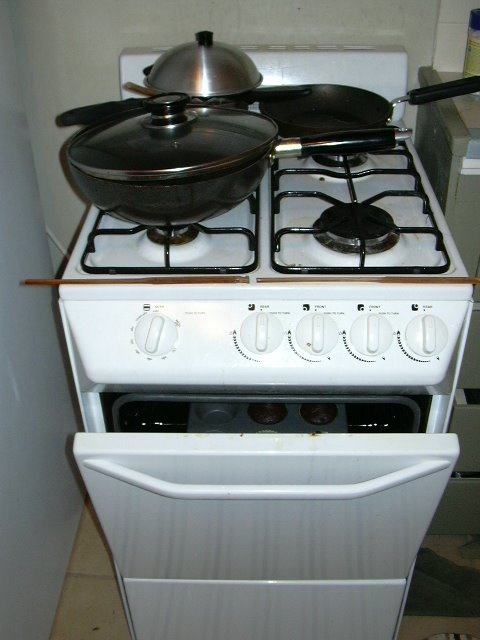
Our apartment has a half-size stove/oven in it -- as you might be able to make out in the picture it's slightly less than two chopsticks wide (these are authentic chopsticks, not that chintz you get at Panda Express).
It works well enough, so long as you only cook two things at once, or four really small things. Again, as you can see -- the Wok is the exception to the two thing rule, unless your second item is the one can of soup at a time pot.
The oven also works fine -- in fact, too fine. Similar to the bus in the movie, Speed, it cannot cook below 450 degrees. Below that temperature the flames just flicker out. For baked potatoes, pot roasts, and chicken pot pies that's fine. But cakes, cupcakes, and brownies always burn.
So I tried a new trick tonight. Turn on the oven to the full 450, pop in the cook at 325-350 cupcakes, then leave the oven partially open. Of course this warms up the apartment in our 71F 91% humidity weather here in November Texas -- so I also have to run the AC.
My next oven will probably be bloated, make only tepid water, and star less interesting food.
Wednesday, November 09, 2005
A Victory for Intelligent Education?
Voters on Tuesday ousted a Pennsylvania local school board that promoted an "intelligent-design" alternative to teaching evolution, and elected a new slate of candidates who promised to remove the concept from science classes. -- from Yahoo! News
Apparently once people find out what their board of education is up to, non-theories (but interesting philosophical arguments) don't do so well. One thing that worries me though is this bit from later in the article:
The challengers also criticized what they called arrogance and secrecy by the incumbent board.
The voters might not be bothered so much by the content of the science classes, as by the fact that those snooty board members never invite the voters to their parties.
Subscribe to:
Posts (Atom)